
Crossing the Chasm: What Eight Years of Driving Electric Teaches Us About Getting People to Change
Apr 03, 2026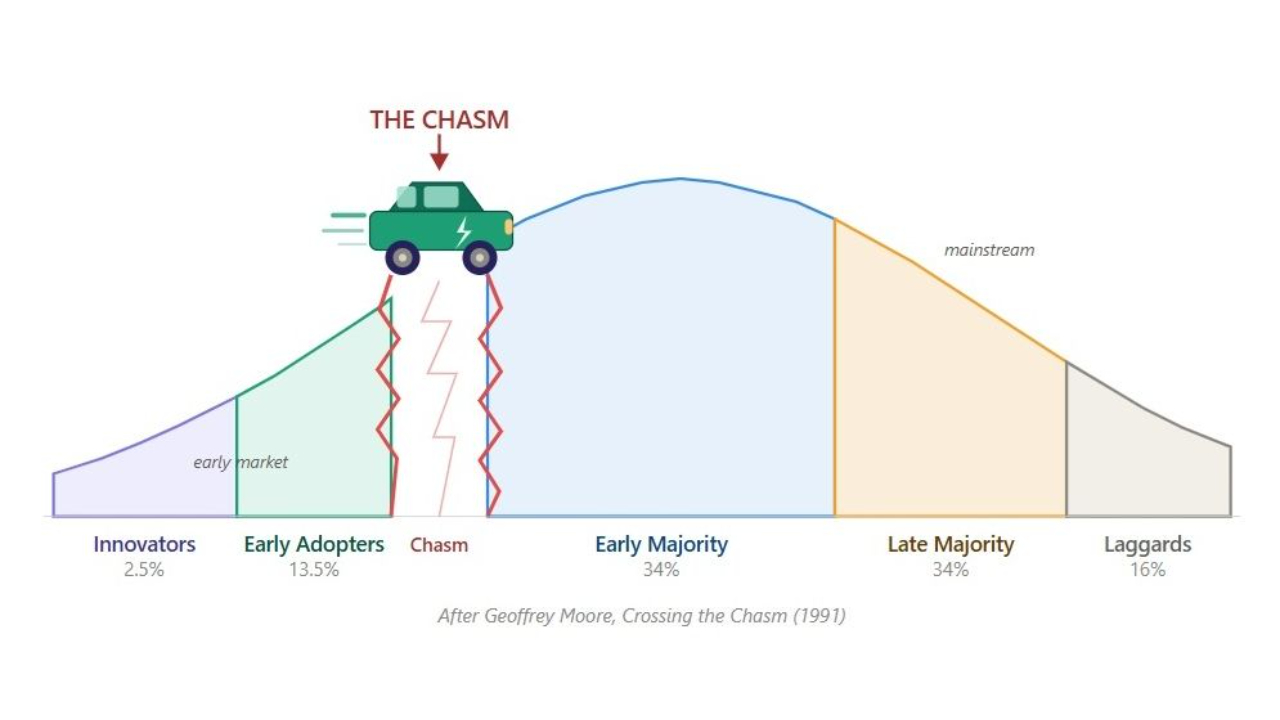
Eight years ago, I bought an electric vehicle. The week I drove it off the lot, petrol had just cracked $2.00 a litre in New Zealand — and most people I knew thought I was a little cuckoo.
I didn't care. I loved not stopping at petrol stations. I loved the silence, the absence of fumes, the fact that I was charging my car from the solar panels on my roof. I loved knowing that every kilometre I drove produced no tailpipe emissions. The savings were real. The environmental impact was real. And the driving experience — effortless torque, no gear changes, no engine noise — was genuinely better.
And still: most people thought I was a bit odd.
Fast forward to today. Petrol in Hawke's Bay is sitting at $3.38 for 91 — when you can get it. Diesel is $3.59. Some stations have run dry. The conflict in the Middle East has sent shockwaves through the Strait of Hormuz, and the global fuel supply chain is under real stress. Suddenly, the electric car doesn't look so cuckoo.
EV sales in New Zealand are skyrocketing. The question is: what actually changed?
Geoffrey Moore and the Chasm Every New Idea Must Cross
In his landmark book Crossing the Chasm, Geoffrey Moore described the painful gap that almost every new technology must traverse before it goes mainstream. His model divides the market into five groups:
Innovators are the first in. They seek new technology for its own sake, they accept imperfection, and they're willing to pay a premium and tolerate the friction. (That was me, eight years ago.)
Early Adopters follow. They see a strategic opportunity — environmental leadership, cost advantage, status — and they can translate an unfinished product into a vision of what it will become.
The Early Majority is where things get hard. These are pragmatic, rational buyers. They don't want to be first. They want proof, peer endorsement, and a complete solution — not a promise of one. They cross when the risk of crossing feels lower than the risk of staying put.
The Late Majority and Laggards follow only when the new thing has become so established that not changing is the stranger choice.
The chasm sits between the Early Adopters and the Early Majority. It's where most innovations stall and die. Evangelism and vision get you across the first two groups. They do not get you across the chasm. Something else does.
Simon Sinek's Warning: Why "Why" Isn't Always Enough
Simon Sinek famously argues that people don't buy what you do — they buy why you do it. Start with purpose, he says, and you'll attract loyal believers.
He's right, for a segment of the market. The Early Adopters came to EVs because of why: climate action, energy independence, a belief in a different future. That's a powerful story, and it built the early market.
But here's the hard truth: for the Early Majority, why is not enough. Pragmatists don't buy your mission statement. They buy when the what and the how stack up clearly in their favour — when the numbers work, when the infrastructure is there, when enough of their peers have done it already and reported back.
I told people for years about why I loved my EV. I told them about the environmental impact. I told them about the solar charging. I told them about the savings.
Most of them nodded politely and kept filling up at the BP.
So What Crossed the Chasm?
It wasn't better marketing. It wasn't more passionate advocates. It wasn't even the technology improving (though it did, significantly).
What crossed the chasm was pain at the pump.
When 91 hits $3.38 and diesel hits $3.59 — and there's a queue, and three stations in your town have run out — the calculus changes completely. The Early Majority doesn't need to believe in clean energy. They need the status quo to become more uncomfortable than the alternative.
Moore called this the "compelling event" — the external pressure that forces pragmatists to act. It's not inspiration. It's disruption. It's the moment when doing nothing stops feeling safe.
Add to that:
- A charging network that has genuinely matured (the Government just announced $52.7 million to more than double NZ's public charging infrastructure)
- A second-hand EV market now wide enough to offer real choice at accessible prices
- Peer adoption — when your neighbour, your hairdresser, your doctor, and your accountant all drive one, the risk feels much lower
- Running cost clarity — electricity costs per kilometre are now so obviously favourable that the maths requires no advocacy
The chasm didn't get crossed by changing people's values. It got crossed by changing their options.
What This Means for Your Business
Here's where it gets interesting — because this story isn't really about electric cars. It's about how any new idea, product, or service moves from niche enthusiasm to mainstream adoption.
If you have something genuinely good that people aren't buying, ask yourself these questions:
1. Who are you actually talking to? Early Adopters respond to vision and values. The Early Majority responds to risk reduction and social proof. If your messaging is built around why you do it, you may be speaking past the people who are one step away from buying.
2. What is the compelling event for your customer? What is the version of "$3.38 per litre" in your market? What has to change in your customer's world — or what can you help them see differently — before the status quo feels more painful than the switch?
3. Have you built enough infrastructure? EVs couldn't cross the chasm when charging stations were rare and ranges were short. What is the equivalent in your business — the supporting ecosystem of trust, proof, process, and convenience — that the Early Majority needs before they'll commit?
4. Who are your reluctant converts? The most powerful marketing for the Early Majority isn't your story — it's the story of someone just like them who was sceptical and switched anyway. A pragmatist trusts another pragmatist far more than they trust an evangelist. Find your converts and get them talking.
5. Are you solving a big enough pain? Features attract Early Adopters. Pain relief attracts everyone else. The EV market didn't grow because the cars got better (they did). It grew because the alternative got unbearable.
A Final Thought
I bought my EV because I believed in a cleaner future. I charged it on solar because it made economic sense and felt right. For eight years I was the odd one out.
Now, with fuel queues and $3.59 diesel and ships sitting off the coast waiting to discharge their cargo, my choice doesn't look eccentric anymore. It looks like exactly the kind of decision that more of us should have made sooner.
The environment was always a good enough reason. But for most people, it took a crisis to make the leap.
Your job, as a business owner, is to understand where your customers are in that journey — and to meet them where they are, not where you wish they were.
Sarah Walker is a Chartered Accountant at Epplett & Co, based in Hastings, Hawke's Bay. Epplett & Co advises businesses across the Hawke's Bay region and wider New Zealand on tax, strategy and business advisory. If you'd like to discuss how any of these themes apply to your business, we'd love to hear from you.
This article reflects the author's personal views and experience and is intended for general interest only.
Stay connected.
Latest updates, news and important information for New Zealand businesses.
We will never sell your information, for any reason.